
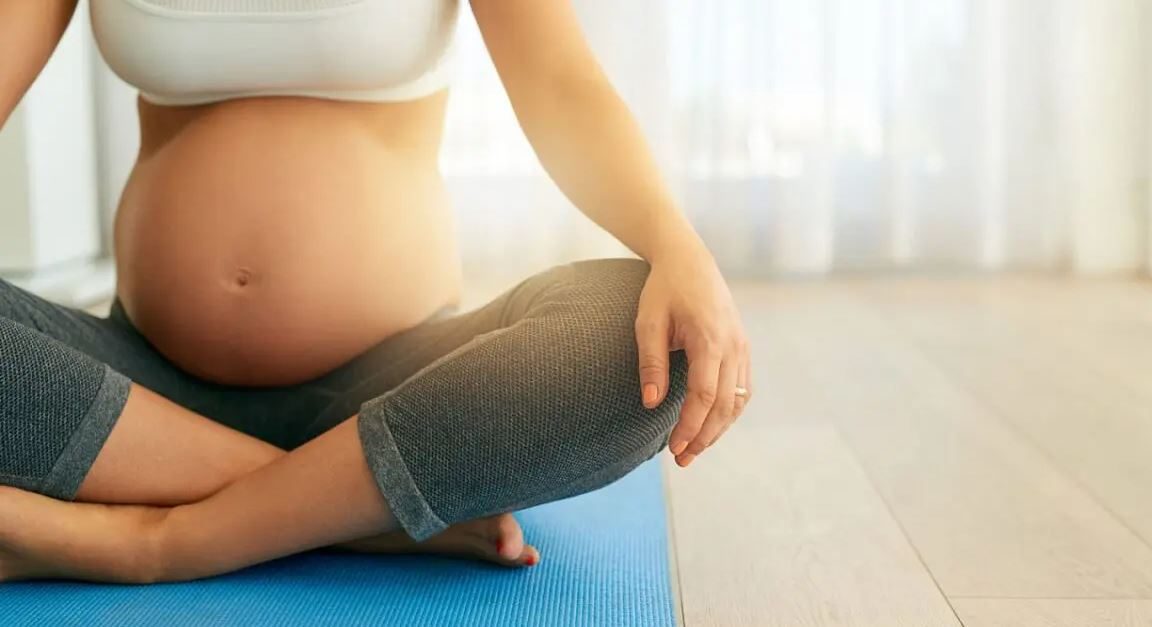
Are you pregnant and want to stay active? Are you thinking about starting or continuing with your abdominal routine because you think it can be beneficial for your pregnancy? Today I will tell you if you can do sit-ups during pregnancy, what exercises are recommended and much more.
When you are pregnant your abdomen begins to undergo some important changes.
This can make you ask yourself some questions about what workouts you can perform for your abdomen and not only for aesthetic reasons, obviously, but rather functional.
Read on to discover and learn more about the basic exercises you can do during pregnancy, and which ones you can’t.
But first of all, let’s answer the most important question…
IS IT SAFE TO DO SIT-UPS DURING PREGNANCY?
The short answer is… It depends, but in general it doesn’t.
The truth is that you should not perform certain activities or exercises without having the OK of your obstetrician, because he is the one who knows your health situation and is the one who can really recommend you if you can train or not.
Now, if the doctor gives you the go-ahead to perform some other exercise, there is no problem; But beware, you will not be able to do any exercise.
At least as far as classic exercises are concerned, such as those we use to mark the abdomen; in case you are pregnant you should never do exercises like the Crunch in all its variants or the leg lift.
This is because when you perform this type of abdominal, the abdominal wall suffers too much outward pressure. And it can lead to aggravation of what is known as “Diastasis rectus abdominis”.
BEWARE OF DIASTASIS RECTUS ABDOMINIS
During pregnancy, the growing uterus stretches the muscles of the abdomen. This can cause the two large parallel bands of abdominal muscles that join in the middle of the abdomen (the rectus muscles) to separate by an abnormal distance, this is the condition called diastasis rectus abdominis. And that can be noticed both when the abdominal muscles are tense, and when you go from lying down to sitting.
Diastasis rectus abdominis can weaken the abdominal muscles, causing low back pain and making it difficult to lift or perform other routine daily activities.
And you may be more likely to develop this condition as a result of pregnancy if you’ve had: multiple pregnancies, a large baby, and you’re short, unfit, or 35 or older.
And not to mention that doing the classic exercises of crunch and leg elevation can aggravate the picture.
WHAT YOU CAN DO IS STRENGTHEN THE BODY CORE
There are certain abdominal exercises focused on strengthening the body core, which you can do with the approval of your doctor.
Let’s go what they are and if you have any questions show them to your doctor to evaluate which one, he recommends.
SITTING KNEE LIFT
I recommend using a chair, sitting on the edge of your couch and applying the next step by step.
- Sit near the edge of a chair.
- Keep your feet flat on the floor directly below your knees.
- Keep your palms down under your hips.
- Slowly contract your abdomen by bending your left knee so that you tilt your pelvis and activate your pelvic floor.
- Then, slowly bring your left knee toward your chest as you exhale.
- Inhale and lower your left foot to the floor, back to your starting position.
- Repeat with your right leg.
- You can do 2-3 sets of 8 to 12 repetitions. In the first trimester you can also add some light weights (up to 3 kilos) on each ankle.
SIDE ABS
- Lie on the floor or on a mat.
- Slowly rotate your body to the left side and bend your knees at a 30-degree angle to your hips.
- Turn your body to the right side so that your knees rise approximately 15 cm from the floor.
- Make sure your body weight rests on the back of your left shoulder and shoulder blade.
- Place both hands behind your head with your fingertips touching (but don’t pull on your neck).
- Bend your torso up in a diagonal position as if you were trying to touch your right knee. Raise as high as you can.
- While performing the steps above, your left shoulder will rise a little off the ground.
- Bring your arms to your knees and bend them a little more.
- Then place your hands behind your head and lower yourself to the original position.
- Repeat this on the other side.
- You can perform 2 sets of 10-12 repetitions on each side.
SIDE PLATE
The side plate can be made in several ways. Here are some options you can apply during pregnancy.
- Starting on the side, place your elbow directly under your shoulder.
- Bend your knees and rest them on top of each other, one straight and the other bent or both straight if this is more comfortable for you.
- Keep your back flat and neutral and focus on your breathing.
- Contract your hips and lift your torso so that it is in a straight line from head to hips while keeping your head and neck straight.
- Hold the position for 20 to 30 seconds and remember to breathe throughout the exercise.
- Repeat with the other side.
STANDING BIKE
This is an excellent exercise to help improve your balance and strengthen your core.
- Stand up, shoulder-width feet apart, and hands behind your head, inhale.
- Then exhale and bring your left elbow to your right knee while doing sit-ups.
- Return to the original standing position and repeat with your left foot and right elbow.
- Aim for 10 to 20 repetitions
DOG/BIRD ABS
- Start at the table position (wrists directly below the shoulders and knees below the hips, with the back straight).
- Contract the core, inhale slowly, lift your left leg and extend it in a straight line behind you while also raising your right arm straight in front of you.
- Exhale, and bring your left knee so that it meets your right elbow in the middle area.
- Inhale, return, and repeat for 10 to 12 repetitions
- Then repeat the same steps with the opposite hand and leg.
WHEN WILL I BE ABLE TO RESUME THE CLASSIC EXERCISES?
Immediately after delivery, your body will undergo a gradual restoration process, so after you’ve had your baby, it’s best to avoid doing crunches until they’ve completely healed. And I’m sorry to tell you that this healing process can take anywhere from six weeks to six months to finish, or even longer.
Therefore, you will have to wait a while before you start training your abs again.
Now, taking into account that each woman is different, you can ask your obstetrician or gynecologist to check your abdominal area to see how they are healing, and in what conditions you are.
Keep in mind that your return to the world of body training does not have to happen immediately.
In addition, you can maintain yourself with exercises such as planks, which focus on the stability of the complete core and obliques to help you recover some strength if the doctor gives you the ok.
FINAL WORDS ON ABS TRAINING IN PREGNANCY
Pregnancy is a natural biological process during which your body undergoes many changes. These changes, such as stretching and softening your muscles, are normal and help you have a healthy baby and pregnancy.
During the postpartum period, it is normal and healthy for these changes to be gradually reversed. There’s no need to rush, and your focus should be on your baby and feeling. The most important part of staying fit during and after pregnancy should always be long-term health.
- If you want to see more about the subject and know if you can do any other type of training during pregnancy, I leave you a link that can be useful: Can you exercise during pregnancy?
- Here I share as a link where we talk about the benefits of Pilates during pregnancy.
- And if that were not enough, I also invite you to know what are the best stretches to do during pregnancy.