
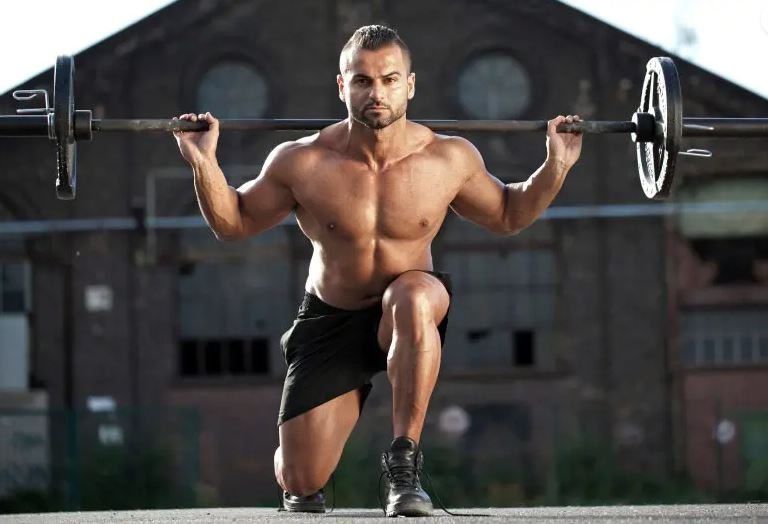
The lunges is another classic exercise with which we can train the legs and buttocks in a simple and economical way without any important equipment. Let’s see how it’s done.
This is an exercise for legs that depending on the length of the step we perform will request the quadriceps to a greater extent by performing a short step; Or failing that, we can focus on the hamstrings and gluteus maximus with a long step.
This variant, as you will notice, is ideal for women, but obviously not restricted to them because there are no limitations in body training.
It is also important to mention that this is an exercise in which we will need to have some balance; So, the ideal is, if they recently started training, do it with little load or if necessary, without it.
As we will see later, we can perform the exercise with both dumbbells and barbell, so the training progression can be quite long thus helping us much more in our particular training goal.
HOW TO PERFORM THE LUNGES CORRECTLY?
- We stand with our legs slightly apart and a dumbbell taken by each hand.
- We take a breath and make a stride forward keeping the back as straight as possible.
- During the stride the requested thigh must be parallel to the floor, that is, horizontally forming an angle almost 90 ° with respect to the calf area.
- We return to the starting position while exhaling the air, and repeat with the other leg.
TIPS FOR TRAINING LEGS WITH LUNGES
After watching a video showing how to perform the exercises, we leave you to read some training tips and get the most benefit from the Lunges.
To get the most out of this exercise, keep your trunk straight. Thus, in the low position, the flexion of the hip and the front of the leg is high. The buttocks also extend to the limit and we can then get a stronger contraction.
For beginners who start barbell training should practice the movement with the barbell in front of them, holding it on the upper chest, this forces to keep the body upright.
When you master the movement, you can try practicing with the bar behind your shoulders in a wide grip.
Keep in mind that performing the exercise with the bar in this position will make you tend to lean which reduces the range of motion and gluteal action. And be careful, because in the low position, the spine is vulnerable, especially if the load is heavy.
The most common mistake when performing lunges is to tilt the torso forward. This poor technique is usually the result of a lack of flexibility of the hips and a weakness in the lumbar region.
Not only is it dangerous for the spine, but it also causes excessive strain on the knee and the rest of the front of the leg. The problem is compounded when the leg is extended beyond the limits.
For safety reasons, the knee should remain above the foot and flexed at 90°. To learn how to do the movement correctly, practice with weightless or dumbbells on the sides of the body.
For greater reach, some bodybuilders and other athletes usually put one foot on a stand. But in reality, this practice can be counterproductive because there is forward rotation of the pelvis and spine in the lumbar region.
To effectively work the hip extensors (glutes and hamstrings), we repeat: keep the trunk straight!
For beginners, deep lunges with light loads or better still without them, not only improves flexibility, but also strengthens the ligaments and tendons of the hip and knee joints. Remember NOT to use heavy loads before you have strengthened the area.