
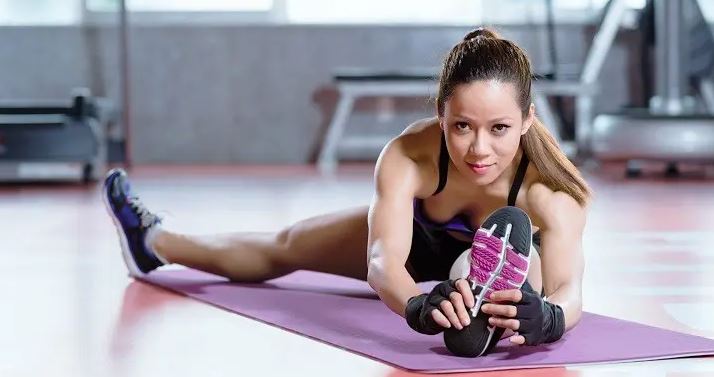
Looking for hamstring stretching exercises? Are you looking to calm those discomforts caused by muscles lacking flexibility? Do you need to improve your performance? Here’s how to perform the best exercises to stretch hamstrings!
Many people tend to exert little or nothing with hamstring stretches, almost as it happens with stretches of the quadriceps, calves and other parts of the body.
But we must be aware that this is a muscle group that contracts quickly, and depending on our posture can suffer from overwork.
Moreover, usually one does not remember this muscle group until the movement patterns are affected or the appearance of some knee pain or back pain is generated.
I know you already know! Stretching hamstrings sometimes takes work, but you should not forget that recurring injuries to these muscles are a common source of frustration for many athletes, so I will keep repeating it, you should never forget to stretch the hamstrings, nor the rest of the muscles.
So, because of the importance of this topic, I would like us to see some concepts before getting fully involved with the exercises, I invite you to read them.
Now, if you already know about the subject and just want to see what new exercises to include in your muscle flexibility development routine you can skip them and go see the exercises directly.
WHAT ARE THE HAMSTRING MUSCLES?
The muscle called the biceps femoris makes up most of the mass in the back of the thigh.
While the hamstrings consist of the semimembranous femoral, semitendinosus and biceps femoris:
- The biceps femoris originates from the rough line of the femur and inserts into the head of the fibula.
- The semimembranosus and semitendinosus originate in the ischial tuberosity. Inserting then into the medial tibial condyle.
- The semitendinosus inserts into the medial tibia.
- The three muscles act to flex the knee. While the semimembranosus and semitendinosus also act to extend the hip.
WHY IS IT IMPORTANT TO STRETCH YOUR HAMSTRINGS?
Performing at least one of these exercises is only one part of the exercise program you should do to prevent injuries.
As I said at the beginning, hamstrings are often overlooked during muscle development because they are in the back of our body.
So, the muscular imbalances related to this muscle, predispose us to injuries, even back injuries due to poor posture.
In addition, our postural habits contribute a lot to these muscles stagnant. Think about it, we lead a sedentary culture where we do a lot of things sitting or standing.
And when sitting we keep our buttocks in a state of rest causing them to become weak. So, then we must request more from our hamstrings when we are standing.
Now, when standing for long periods we tilt our hips forward, preventing the glutes from intervening, so our hamstrings must work harder.
This together is very detrimental to our posture and sports performance, in this sense this and all other stretching exercises should be done in the long term, since the goal is to achieve long-term results.
WHY DOES IT HURT WHEN STRETCHING THE HAMSTRINGS?
Why does it hurt when stretching your hamstrings? Well, these fall into the classification of “postural muscle”. And as you can imagine, postural muscles are used to maintain an upright posture.
They contain, predominantly, slow-twitch muscle fibers and are designed to function for a long period without fatigue.
Therefore, they may be prone to hypertonia. That is, these kinds of muscles tend to shorten over time unless we stretch them in their full range of motion on a regular basis.
In turn, they contain strong connective tissue fibers so that these muscles can work as strong hip extensors and knee flexors. This contributes to you noticing some difficulty when you do the stretches.
HAMSTRING STRETCHING EXERCISES
STATIC HAMSTRING EXTENSION
Hamstring stiffness can be a limiting factor for optimal performance in particular sports and an intrinsic risk factor for sports injuries.
And static stretching has been consistently reported in the literature as an effective tool in preventing injuries related to inflexibility.
- Stand up, and position your back upright.
- Separate the legs to a shoulder width.
- Descend the trunk dropping your arms to the ground.
- If you can, touch the ground or tomato ankles and hold this position while maintaining fluid and steady breathing.
HAMSTRING STRETCH WITH SUPPORT
This hamstring stretching exercise relies heavily on pelvic positioning.
If you are able to keep your back straight down while performing this stretch you will achieve a significant improvement in the results.
- Stand up, and position your back upright.
- Separate the legs to a shoulder width.
- Descend the trunk dropping your arms to the ground.
- If you can, touch the ground or tomato ankles and hold this position while maintaining fluid and steady breathing.
HAMSTRING STRETCH WITH SUPPORT
This hamstring stretching exercise relies heavily on pelvic positioning.
If you are able to keep your back straight down while performing this stretch you will achieve a significant improvement in the results.
- To perform this stretching position, stand in front of a chair or table.
- Place, on this, the leg to stretch.
- Keep your chest and back straight.
- Lean forward with your hips until you feel the stretch in the back of your thigh.
STRETCHING ON BOARD
This movement minimizes the risk of injury to the lower back and makes it easier to keep the pelvis stable throughout the movement.
- Standing, and with one leg up on a bed, board or bench.
- Try to keep your hip neutral (keep the knee of the other leg toward the floor).
- Keep your chest upright and perform a curvature of your lower back (such as leaning forward), without allowing the knee of the stretching leg to bend upward.
HAMSTRING STRETCHING ON THE FLOOR
This is another well-known variant, ideal to perform after running and you do not have much support to do the standing position stretch.
- Sit with one knee bent and the bottom of your foot against the inside of the opposite thigh.
- Extend the other leg in front of you.
- Maintain proper pelvic alignment to avoid lower back pain during this movement, which in turn will maximize hamstring stretching.
- Finally, tilt the trunk to the side of the leg to stretch and press keeping the right time.
STRETCHING AGAINST THE WALL FRAME
The hamstring stretch in front of a wall frame is a fully validated exercise, and in turn it is easy to perform in terms of how the pelvis is held in the correct position.
- This exercise is performed by keeping one leg resting on the wall and the other on the floor.
- Slowly you should approach the door with both legs extended until you clearly feel the stretch on the area.
- Adductor Stretching Exercises
- Back Stretching Exercises
- The Best Forearm Stretching Exercises
- Exercises for quadriceps stretching
- The Best Exercises to Stretch the Hamstrings
- The Best Exercises for Stretching Calves or Calves