Let’s see what it is and how to properly use the wheel for abs. A tool that can be the key to achieving stronger and more stable abs.
Today’s abs routines are much more versatile than ever. You can train your abdomen with crunch series, leg lifts, spins and boards.
But these basic workouts increasingly incorporate some tools such as Swiss balls, medicine balls, dumbbells and kettlebells.
And if you’re looking for one more way to generate variability in your routines, and why not one more level of training, then it’s time to consider incorporating the abs wheel into your exercises.
THE ABDOMINAL WHEEL
It is easy to forget the abdominal wheel, a very good abs training accessory that has been around for years.
And it is probably one of the most complete abdominal training devices, and effective if you are looking to strengthen your entire body core.
In fact, in real life your core works this way, as a unit, so any opportunity to train it this way is going to be beneficial.
However, the deployment of the ab wheel is not easy, or at least it is not easy to do correctly.
Before training with an abdominal wheel, you need to spend some time training, respecting an adequate progression to be able to focus then on correctly performing the exercise with the abdominal wheel.
BEWARE OF MOVING TOO FAST
The main mistake people make when they do extensions with the AB wheel: it boils down to trying to go as far as possible when you start. However, this is a fixed prescription to start suffering from low back pain.
You have to learn to feel how your abs fight against the extension of the back and stop before the extension in the abdominal wheel is such that it ends up affecting you negatively; If you don’t, you’ll put a bad strain on your spine and be in danger of injury over time.
As you strengthen your core you can go further and further.
HOW TO PERFORM THE EXERCISES WITH ABDOMINAL WHEEL?
Let’s analyze the two main variants to train with the abdominal wheel whether you are a beginner or if you are more advanced:
START TRAINING WITH KNEE EXTENSIONS
If you want to start training with the abdominal wheel the best way to do it is to do it on your knees.
Try this variant until you feel comfortable with the position and notice that your core is stronger.
I assure you that eventually you will have your body ready to go to the floor and start with the complete extensions, where the real exercise takes place.
To avoid hurting your knees, you can put a mat or yoga pad on them when exercising.
THE COMPLETE EXTENSION IN ABDOMINAL WHEEL
Once you are on the ground, the main focus will be to keep the core contracted as you move forward with the wheel, avoiding at all costs that the spine is hyperextended and your hip leans down.
When climbing you should actively contract your abs, even if you feel that it is not necessary. And again, this will not be so difficult, the most difficult thing (I repeat it again) is to roll while controlling the position of the lower back, that’s the challenge.
Perform the same movement to perform the necessary repetitions according to your routine, focusing again on keeping the movement slow and controlled, contracting the core to pull the wheel towards you.
The Abdominal Sit-Up is an exercise that serves to tone the waist and abdominal muscles in general. Let’s see how this exercise is performed plus some training tips!
“V-abdominal contractions” have a reputation for working the lower abdomen, where many of us find it difficult to focus, so it could be a very complete exercise when it comes to incorporating it into your routines.
Of course, it is an exercise that to perform it correctly you must have previously built, a good base core.
So, if you are looking for an exercise for beginners, this one in particular you should leave it aside and focus on other exercises for abs such as:
ABDOMINAL PLANK EXERCISE
CRUNCH EXERCISE
On the other hand, if you are looking to give greater focus to abdominal training, I invite you to continue reading, then I will explain how to perform this exercise correctly.
I even share some tips to carry out and achieve the results you are looking for your body.
HOW TO PERFORM THE ABDOMINAL SIT-UP?
Sitting on a flat bench or on a carpet on the floor we will proceed to place our hands to the sides to maintain balance.
Stretch your legs and bring your knees to your chest. Always maintaining the contraction of the abdominal muscles throughout the movement, and without supporting the legs until the end of the exercise.
As for breathing, we should exhale when we contract the abdominals and inhale when we stretch our legs.
Tips for performing the abdominal Sit-Up on a flat bench
The Abdominal Contraction exercise, although it works the area in general, does not have much focus on the rectus abdominis since it is working statically. It acts mainly in the psoas, iliac and rectus femoris where the effort is more focused.
For the most effective execution, maintain trunk stability and bring your knees as close to your chest as possible. Doing this results in greater shortening and stronger muscle contractions in the abdominal muscles.
To make sure you keep the trunk in place as much as possible, keep your arms extended. Do not bend or stretch your arms during execution.
If there is any elevation of the trunk, it should be only of the head and shoulders, the hips not. If the hips move upwards, you will only intervene the hip flexors to make the effort, not the abdominals.
Make sure you lean back no more than 45-60°. If you lean more than this, again… You will only achieve greater involvement of the hip flexors, not the abdominals.
If you want to add some feeding tips to accompany the training and development of your abdomen you can visit the following article: 10 FEEDING TIPS TO MARK THE ABS, or you can also visit… HOW TO DEVELOP ABS?
The Crunch works the muscles of the rectus abdominis, it is a basic movement to implement in any abdominal exercise routine. Let’s see how it is done and some tips.
The Crunch is a basic exercise, it is one of the most classic ways to develop the muscles of the rectus abdominis.
At the same time it is beneficial to complement any weight training and abdominals, and it will even serve us a lot to improve physical condition in general.
A well-trained abdomen limits back pain and possible injuries that we can suffer from lifting.
But one of the most recurrent questions is… Will this exercise help me have a flat stomach? Yes, of course, as long as they do not forget to maintain proper nutrition and perform a good Cardio session. So, let’s see how to perform the exercise correctly.
HOW TO PERFORM CRUNCH CORRECTLY?
1Lie on your back and bend your knees at 45°. Keeping your hands on your temple and your eyes fixed on the ceiling.
2Breathe a little more than usual and, holding your breath, take your head and shoulders off the floor.
3Arriving with the forehead at the tip of the knees would be marking the limit of ascent of the exercise.
4Hold this position for one second.
5Exhale and support your shoulders and head again.
6Relax your body with a slight pause before starting again.
7To make the exercise more difficult, you can put a weight on your chest, keep your legs suspended on the floor, or place your feet on a bench or against a wall.
The effect of contraction rather focuses on the upper abdominals. However, the lower abdominals and hip flexors also contract to ensure stability of the abdomen and pelvis, thus allowing proper movement of the upper body.
TIPS TO CORRECTLY PERFORM THE ABDOMINAL CRUNCH
Let’s see a series of training tips that will allow you to obtain better results and work more safely when performing both this and other exercises for abdominals:
The speed of execution should be slow and constant.
To achieve a higher level of training they can place a weight disc on the chest or a barbell.
As the postural muscles of the abdominals become stronger, they can be trained with longer sets. But we suggest sets of 12 to 20 repetitions, if you can do more, instead try to make the exercises harder.
Remember to work all the muscles that make up this group, not just those that are visible on the surface!
Avoid placing your hands behind your head, as we often end up pushing it to perform the exercise. This can lead to cervical problems. The easiest way is to keep your hands on your temple or chest.
We must work without blocking the feet and knees apart so as not to limit the activity of the hip flexor, iliac psoas and rectus femoris, and thus avoid tension and pain in the lower back.
Why do you have to lower the trunk completely? Well, for the head and shoulders to touch the ground, with this you get the abdomen and spine to enter a kind of stalemate.
The most important of this exercise is to avoid flexing the torso at the time of ascent. When the spine is flexed, shoulder rotation creates excessive shear and compression forces that can damage the vertebrae and intervertebral discs.
If you’re having trouble maintaining your head and shoulder position, place your fingers behind your head. Avoid putting your hands behind your neck, as it is not recommended, and if you do not pull from there to avoid hurting the cervical vertebrae.
When you lift the trunk, the respiratory blockage that occurs when you exhale slowly after gathering air; This gives more strength and creates intra-abdominal pressure that helps protect the spine.
Conversely, inhalation during ascent tends to limit movement; which also makes you have less strength to perform the Crunch.
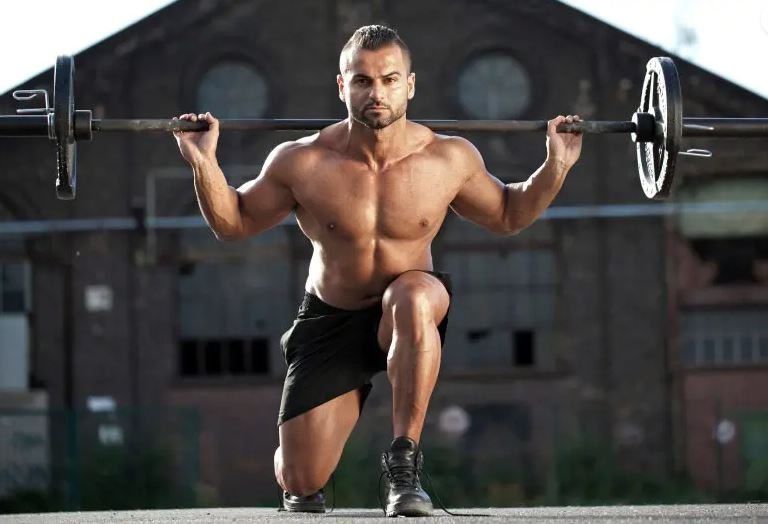
The lunges is another classic exercise with which we can train the legs and buttocks in a simple and economical way without any important equipment. Let’s see how it’s done.
This is an exercise for legs that depending on the length of the step we perform will request the quadriceps to a greater extent by performing a short step; Or failing that, we can focus on the hamstrings and gluteus maximus with a long step.
This variant, as you will notice, is ideal for women, but obviously not restricted to them because there are no limitations in body training.
It is also important to mention that this is an exercise in which we will need to have some balance; So, the ideal is, if they recently started training, do it with little load or if necessary, without it.
As we will see later, we can perform the exercise with both dumbbells and barbell, so the training progression can be quite long thus helping us much more in our particular training goal.
HOW TO PERFORM THE LUNGES CORRECTLY?
We stand with our legs slightly apart and a dumbbell taken by each hand.
We take a breath and make a stride forward keeping the back as straight as possible.
During the stride the requested thigh must be parallel to the floor, that is, horizontally forming an angle almost 90 ° with respect to the calf area.
We return to the starting position while exhaling the air, and repeat with the other leg.
TIPS FOR TRAINING LEGS WITH LUNGES
After watching a video showing how to perform the exercises, we leave you to read some training tips and get the most benefit from the Lunges.
To get the most out of this exercise, keep your trunk straight. Thus, in the low position, the flexion of the hip and the front of the leg is high. The buttocks also extend to the limit and we can then get a stronger contraction.
For beginners who start barbell training should practice the movement with the barbell in front of them, holding it on the upper chest, this forces to keep the body upright.
When you master the movement, you can try practicing with the bar behind your shoulders in a wide grip.
Keep in mind that performing the exercise with the bar in this position will make you tend to lean which reduces the range of motion and gluteal action. And be careful, because in the low position, the spine is vulnerable, especially if the load is heavy.
The most common mistake when performing lunges is to tilt the torso forward. This poor technique is usually the result of a lack of flexibility of the hips and a weakness in the lumbar region.
Not only is it dangerous for the spine, but it also causes excessive strain on the knee and the rest of the front of the leg. The problem is compounded when the leg is extended beyond the limits.
For safety reasons, the knee should remain above the foot and flexed at 90°. To learn how to do the movement correctly, practice with weightless or dumbbells on the sides of the body.
For greater reach, some bodybuilders and other athletes usually put one foot on a stand. But in reality, this practice can be counterproductive because there is forward rotation of the pelvis and spine in the lumbar region.
To effectively work the hip extensors (glutes and hamstrings), we repeat: keep the trunk straight!
For beginners, deep lunges with light loads or better still without them, not only improves flexibility, but also strengthens the ligaments and tendons of the hip and knee joints. Remember NOT to use heavy loads before you have strengthened the area.
Do you want to know how to make your muscles mark the veins? You are not alone, for many, vascularization is the hallmark of an advanced physique. Let’s see how to achieve it with these 3 tips!
As you will see in the development of this article, there are 3 methods to obtain a more vascularized body and that allows you to give a plus in some bodybuilding competition.
None will make you increase your veins in size altogether, this cannot be achieved, but if you will make changes in your body so that you notice in certain changes!
HOW TO ACHIEVE MORE VASCULARIZED MUSCLES?
FOCUS ON YOUR CARDIO WORKOUT
First, CARDIOVASCULAR EXERCISE increases blood flow and the rate with which blood flows throughout the body.
As your heart beats at a rapid rate, blood pressure increases, vasodilation and capillary proliferation are stimulated.
In short? Cardio promotes the dilation of arteries, veins and capillaries throughout the body while improving the health of the heart, lungs and allowing more nutrients to reach the muscle.
BEWARE OF FLUID RETENTION
The second way vascularization is improved is by reducing water retention.
Unwanted fluid can be kept in the interstitial and subcutaneous spaces throughout the body and can spoil the appearance of the body when preparing for a competition.
As in a bodybuilding competition the factor of “fluid retention” counts a lot, improving this can also be achieved with cardiovascular exercise, for example, by promoting sweating.
Now, it is important to clarify that it is not very healthy to try to show a body with more venous muscles in this way.
Keep in mind that good hydration is necessary in any type of training. And although in competitions certain “traps” are usually used under normal conditions, we should not resort to it.
DECREASES % OF BODY FAT
A third way, and one of the most influential in increased vascularization, is by burning excess fat, including subcutaneous fat responsible for hiding the muscles and vascularization.
This, again, we can achieve with cardiovascular training and with an adequate meal regime.
Why does this point influence so much? Because the less fat tissue, the greater venous and muscular visibility, the body feels more defined and more torn.
CONCLUSION ON HOW TO ACHIEVE GREATER MUSCLE VASCULARIZATION
How you see cardiovascular exercise can be one of the most powerful tools to help you achieve a semblance of competence, obviously I’m dismissing the fact that you’re doing high-intensity weight training.
If you don’t, that’s where you should start.
Finally, keep in mind that the fact that your muscles are more or less venous also depends on your own body, which offers certain limits and to which you should never compare with another person.
There are many variants that come into play whether nutritional, genetic, training, and more than ever will allow 2 bodies to look the same, for this reason do not focus too much on an aspect that only serves to compete and does not demonstrate the reality of your abilities.
Would you like to have much bigger muscles but don’t know how much weight to lift? Don’t worry, in this article I will explain how to calculate how much weight you have to lift to gain muscle!
Trainers and physical trainers call this intensity, and in fact we have already talked about THE INTENSITY IN TRAINING.
As you know there are all kinds of formulas to find out what intensity is right for your own body. You can even do it by trial and error (although this is not the most efficient way to achieve it).
For example, you can use a load that is heavy enough to provide a challenge, but not so heavy as to jeopardize technique and control.
And if you’re twisting, shaking, shaking, or any other mode of body distortion to complete the movement, you’re lifting too much weight.
Although this is “the method of intuition”, to which we all go in our principles, it is not recommended.
Let’s see then the correct way to calculate the amount of weight that must be lifted to gain muscle mass.
HOW TO BUILD MUSCLE MASS CORRECTLY?
As we saw in the article on how to calculate our strength, the intensity of an exercise is determined by the 1RM method (1 MAXIMUM REPETITION). In case you do not remember what, this is, you can enter the link where I explain how to calculate it.
Basically, “1 maximum repetition” is the absolute maximum weight that can be lifted only once, maintaining the correct technique of the exercise to be performed.
And it is very good to take the time to calculate it because the minimum intensity range in which you will begin to develop strength and muscles is between 60% – 65% percent of your 1RM.
What does this mean? Well, if the maximum weight you can lift only once, for a given exercise (let’s assume in the arm curl), is 20 kg, the minimum weight you should use to gain muscle mass is 12 to 13 kg.
since it will not stimulate your maximum level of strength development, to achieve the maximum level it is recommended to use a load that is between 80-90% of your 1RM.
That is, if you could lift 20 kilos to do a single repetition, this means that the maximum weight range now consists of using between 16 and 18 kg for the case of the bicep curl.
We can affirm that using a weight below these ranges (65% – 80% of your 1RM) will not favor muscle development but you will be focusing more on the development of muscle endurance.
It is very important to know this, as you may want to incorporate lighter loads according to your training periodization, in order to give your muscles a rest, while improving their ability to generate force for longer periods.
HOW DO REPETITIONS INFLUENCE MUSCLE DEVELOPMENT?
We already saw the issue of weight or load, but the number of repetitions, or better the range of repetitions is what ends up giving closure to the issue of knowing how much weight to lift to develop more muscle.
I said that the idea was to train 65% – 85% of the 1RM, but 65 is not the same as 80, right?
Let’s look at it as follows:
Training at 65% (it was 13 kilos for the bicep curl), and in theory here you would be doing about 14 repetitions before fatigue.
Training at 85% (which was equivalent to 17 kilos for the same exercise) you could do (in theory) about 4 repetitions before breaking the technique.
WHAT PERCENTAGE SHOULD YOU CHOOSE THEN? 65% OR 85%?
Let’s now incorporate the concept of series and repetitions, so if your goal is to develop muscle mass, it will be neither one nor the other.
With the 16/17 kilos and 4 repetitions, you would focus on strength.
While with the 13 kilos and 14 repetitions resistance training will predominate.
The ideal rep value is one that allows you to reach the point of muscle failure between repetition 8 and 12. Tweet
That is, if you decide to train with 15 kilos for the curl (75% of your 1RM) and in the last series you cannot pass 10 or 11 repetitions maintaining the correct technique of the exercise.
It is there that you will be developing the maximum level of muscle mass possible.
YOU HAVE TO COMBINE WEIGHT AND REPETITIONS TO BUILD MUSCLE MASS!
In short, within this range you must choose the heaviest weight possible but that allows you to reach muscle failure in repetition 9, 10 or 11 of the last series. And this is important huh, always in the last series and not before.
Another important point is that you should not reach failure in each of the exercises of your routine, it is good that you change the scheme so that each week it touches a different exercise by muscle group, in this way you will avoid a picture of overtraining.
Remember that the lower the number of repetitions within that range, the higher the weight you should use, and vice versa.
As you begin to build muscle and become stronger, you will notice that the effort will be less and less and you will begin to perform several more repetitions than scheduled.
This means that your body is improving and adapting to training, and the weight that was once ideal is no longer the right one for your new level.
That’s when it’s time to implement one of the following strategies to continue building muscle optimally.
STRATEGIES TO CONTINUE MUSCLE DEVELOPMENT
You can increase the weight you’ve been using on that particular exercise by a small increase in load.
You can increase the number of sets, to reach muscle failure in the aforementioned range.
Or you can reduce the rest time between sets.
As you can see, there are no excuses, perhaps the most difficult thing is to start, establish the optimal range of repetitions and weight.
But once this is defined, the system follows the same pattern, and it only remains to make small adjustments in the routine to avoid stagnation.
You no longer have excuses to overcome your current limits, and develop more muscle mass, just remember that training is one of the three pillars; do not forget nutrition and rest. The other two pillars also have their specific strategies aimed at muscle development.
What is Protein or Nitrogen Balance?
What to Eat to Gain Muscle Mass?
How many times do you have to eat a day to lose weight or gain weight?
Metabolism: Catabolism, Anabolism and Muscle Development
10 + 1 Tips to build muscle mass
How Much Muscle Can You Develop Naturally and at What Speed?
How to gain weight and muscle mass according to your body?
How much weight do you have to lift to gain muscle mass?
Eggs and muscle training: Are they bad for your health? How many eggs can be eaten per day? Raw or cooked? What if I’m training? Below I help you answer these and more questions!
Eggs are among the most nutritious foods on the planet. If you don’t believe me, consider this… A whole egg contains all the nutrients needed to turn a single cell into a small chick.
However, and despite their virtues, eggs have had a bad reputation, and basically because the yolks are rich in cholesterol. In fact, a single medium-sized egg contains 186 mg of cholesterol, which is 62% of the recommended daily intake.
People believed that if you ate more than one egg, it would increase blood cholesterol and contribute to the onset of cardiovascular disease. But it turns out that in reality this is not so.
Let me explain how the issue of cholesterol works and how we associate it with this food so that at the end of the article, we can know how many eggs we can eat per day …
EGGS, TRAINING AND HEALTH
Eggs are an excellent, low-calorie way to get protein, vitamins, minerals, antioxidants and other healthy nutrients.
One large egg can contain 6 grams of high-quality protein in just 70 calories. Eggs also contain varying amounts of 13 essential vitamins and minerals. But how many eggs can you eat per day?
For many years, eggs were attacked because of their high cholesterol content and possible association with cardiovascular disease.
However, the most recent studies show that the cholesterol present in eggs has very little impact on the amount of total cholesterol in our body.
In case you don’t know, cholesterol is a compound found in the body of animals. And it is necessary to produce hormones, vitamin D and certain substances that help us digest food.
Our body produces cholesterol, but in addition to the cholesterol we produce, we also get a small amount from some of the foods we eat.
HOW DOES THE BODY REGULATE CHOLESTEROL?
Cholesterol is often seen as a negative word. When we hear it, we automatically start thinking about medications and heart attacks.
But the truth is that cholesterol is a very important substance for our body. It is a structural molecule that is an essential part of every cell membrane.
It is also used to produce steroid hormones such as testosterone, estrogen, and cortisol.
Without cholesterol, we wouldn’t even exist.
Given how incredibly important cholesterol is, the body has developed elaborate forms to ensure that we always have enough available.
Because getting cholesterol through diet wasn’t always straightforward, the liver has the ability to produce cholesterol.
But you didn’t know this! When we eat a lot of cholesterol-rich foods, the liver begins to produce less and less (1, 2).
So, the total amount of cholesterol in the body changes very little (if at all), in these cases it only comes from the diet rather than from the liver (3, 4).
Therefore, the liver itself produces large amounts of cholesterol. But if we start eating a diet that includes more and more eggs, the liver will begin to produce less cholesterol, since you will not need to.
HOW DOES EGG INFLUENCE CARDIOVASCULAR DISEASE?
Many studies have looked at egg consumption and heart disease risk.
All of these studies are called observational studies. In studies like these, large groups of people are followed for many years.
Researchers then use statistical methods to determine whether certain habits (such as diet, smoking, or exercise) are linked to a lower or increased risk of disease.
These studies, some of which include hundreds of thousands of people, consistently show that people who eat whole eggs are no more likely to develop heart disease. Some of the studies even show a reduced risk of stroke (a and b).
However, one thing worth noting is that these studies show that diabetics who eat eggs DO have an increased risk of heart disease (C).
SO, DO YOU HAVE TO EAT MORE OR LESS EGGS?
For a long time, people have been advised to limit egg consumption to no more than 1 egg yolk a day (the white is mostly protein and has low cholesterol content).
Common recommendations include a maximum of 2 to 6 yolks per week. However, there really isn’t much scientific support for these limitations (5), what’s more, luckily, we have several excellent studies that can put our minds at ease.
In these studies, people are divided into two groups… One group eats several whole eggs per day (between 1-3), the other group instead eats something different to replace the eggs. The researchers then follow the people for several weeks/months.
These studies show that:
In almost all cases, HDL cholesterol (the “good” cholesterol) increases (6, 7).
Total and LDL cholesterol levels (the “bad” cholesterol) usually do not change, although they sometimes increase slightly (8, 9).
Eating eggs enriched with omega-3s may lower blood triglycerides, another major risk factor (10, 11).
Blood levels of carotenoid antioxidants such as lutein and zeaxanthin increase significantly (12, 13).
We could say that the response to total egg consumption depends on the individual.
In 70% of people, it has no effect on total or LDL cholesterol. However, in 30% of people (called “hyper responders”), these figures rise slightly (18).
In summary, it could be stated that up to 3 whole eggs per day are perfectly safe for healthy people trying to stay healthy, at least for 7 out of 10 people.
HOW MANY EGGS PER DAY CAN A TRAINEE EAT?
We already saw that the maximum number of eggs that can be eaten daily is between 1-3, and these include whole eggs, those that include white and yolk. But if you are training and you are looking for an excellent source of protein in eggs, you have to make some adjustments.
First, for the muscle building process to be successful, an essential amino acid called leucine is important. And our body requires 2.5 grams of leucine for the muscle building process to begin. Reaching this amount can be achieved by eating 4-6 eggs a day. But… Wouldn’t we be overdoing it then?
Yes, but there is something to consider how it is formed and what is the nutritional composition of the egg:
On the one hand we have the clear (the “transparent” part) that contains very small nutritional values, but has a very high protein content.
On the other hand, there is the yolk, which has many nutrients. Basically, this is where most of the nutrients in an egg are found.
If a bodybuilder only eats the egg yolk constantly, it will not trigger the muscle building process, no matter how many eggs he eats.
And while it has many nutritional benefits, this automatically disqualifies egg yolk in any bodybuilding workout.
What bodybuilders need is egg white, which is high in protein.
In this sense you should consume high levels of egg white, as it is the most important part, as it will activate the muscle building process.
So how many eggs can I eat in a day? My recommendation is up to a maximum of 3 whole eggs a day (white and yolk) and then supplementing only with egg white, depending on the amount of protein you need depending on your body mass.
Of course, never eat raw eggs, you run the risk of suffering a picture of salmonellosis, and you will also incorporate only a fraction of the proteins, since the raw egg white is not well absorbed.
Horizontal rowing is a classic exercise for back training, but many people who are just starting to train with weights wonder what muscles work when performing this exercise. Let’s see then how it is done and what is it for?
Today we will help you by providing some theory about it and obviously how to perform the correct technique of the exercise.
Let’s start with the basics, although it may not seem like it, this is a typical exercise for the back, in which different muscle groups come into play such as the dorsals and trapezius; Even the deltoids and biceps are requested although these to a lesser extent.
Now, in the horizontal rowing the correct position of the body, as we will see later in the images, is one of the determining factors when performing it.
A correct position of the body gives us the certainty that we are working the muscles we want. And what is more important we can avoid injuries or pain.
HOW TO PERFORM HORIZONTAL ROWING WITH DUMBBELL?
We take the dumbbell in semi-pronation, and rest on the bench the knee and the opposite arm.
With the back fixed and straight we inspire and pull the dumbbell, as if we were starting the engine of a boat (so that it is understood) until leaving the arm parallel to the line of the body.
Finally, we descend in a slow and controlled way while we exhale the retained air.
TRAINING TIPS TO APPLY IN HORIZONTAL ROWING
Let’s see some tips to exercise our bibs to the fullest with this excellent exercise for back.
Pull hard to start the movement. This helps to move the load and allows to work in the full range of motion a key point for the complete contraction of the muscles.
For the final position, slightly lift the working shoulder but without this implying re-raising the load. Try to keep your shoulder and back parallel to the ground for most of the movement.
Avoid using a very heavy load as it limits the range of motion.
The torso must remain horizontal and must maintain the normal curvature of the spine. Focus well on not rounding your lower back, this can cause injury.
To further improve the work of the latissimus dorsi (and the muscles of the upper and middle back), use a pronation grip so that the palm is facing back. When raising the dumbbell, keep the elbow outward in alignment with the shoulders.
To request the entire wide dorsal, do the rowing to an arm in two ways, that is, with a neutral grip and a pronation grip.
Do not try to use your bicep during this exercise. Remember to use your shoulder and back muscles to lift the load.
The hip twist (or Russian twist) will help you strengthen the oblique muscles, let’s see how it is done correctly plus some variant and training tips.
The hip twist helps to strengthen mainly the internal and external oblique muscles (basically what are known as lateral). But it also acts on the rectus abdominis to a lesser extent.
The hip twist or Russian twist is an exercise that with a little effort any beginner can start implementing as it can help increase the mobility of the lower back while strengthening the oblique muscles.
Now, if you suffer from low back pain, you may need to avoid it or at least reduce the range of motion of exercise to limit the stress exerted on the lower back area.
Let’s see how it is done!
HOW TO PERFORM HIP TWISTING TO TRAIN OBLIQUES?
Lie on your back with your hands at your sides (T-shaped), palms down.
Bend your hips and knees at a 90-degree angle. In the starting position, your thighs should be vertical and your lower legs parallel to the floor.
Lower your knees to the left until your thighs almost (or completely) touch the floor. Try to maintain knee flexion throughout the movement.
Then repeat in the opposite direction. Slowly turn your lower body to the right so that your hip and the outside of your right leg fall toward the floor as much as possible but without feeling much tension or pain.
EXERCISE VARIATIONS WITH EXTENDED LEGS
Perform the turn with your legs straight, bringing your feet to the ground instead of bringing your knees.
This variant is an extremely advanced exercise. Don’t try it until you’ve mastered the basic patterns of core movement.
ADDITIONAL TIPS FOR PERFORMING THE HIP TWIST
Remember that your thighs should be perpendicular to the floor and your legs should be parallel to the floor.
Focus on contracting your abs and lowering your legs (as much as you can) to the side, while keeping your shoulders in contact with the floor.
It is important that you lower your legs without changing the curve in your hips or knees.
To make hip twisting easier, you can hold onto a fixed object such as a bench or shelf with your hands up and behind your head (instead of your sides).
The hip lift is a very good and effective exercise for strengthening and developing the abdominal muscles. Let’s see how it is done plus some tips.
This is an exercise that you should try in your abdominal training routines, it is complex to perform but it is a good complement if what you are looking for is to develop the abdomen efficiently.
Below I explain the step by step and some tips on how to perform the movement correctly and safely, in order to avoid injuries of any kind and get the most out of it.
Try to follow the technique correctly because this is the best way to achieve results in less time and safely; If you are just starting to train, perhaps the best option is to see other exercises for abs that are simpler to perform before trying this movement.
HOW TO PERFORM THE HIP LIFT?
Lie on the floor with your arms at your sides.
Now bend your knees around a 75-degree angle and lift your feet off the ground about 5 cm.
Using your lower abs, bring your knees up keeping the curve at a 75-degree angle to your legs. Continue with this movement until you raise your hips off the floor by rolling your pelvis back. Exhale as you perform this part of the movement.
Contract your abdominal muscles at the top of the movement for a second and then return to the starting position slowly as you inhale. It is important to maintain controlled movement at all times.
Repeat the procedure for the recommended number of reps based on your training level and routine.
The hip lift proposes to direct the effort to the rectum of the abdomen. This exercise also helps to strengthen the lower ones being very good for working the key muscles that help build the core of the area.
The secondary muscles involved in this exercise include the thighs and hip flexors.
TIPS FOR PERFORMING THE HIP LIFT CORRECTLY
As we said before, be sure to check the technique very well in this exercise; Progress slowly along the entire range of motion.
Raise your hips just a few centimeters off the ground, it is not necessary to raise them much, you should feel the abdominal contraction when doing so.
A simple way to feel the movement is to have your belly button tuck inward while flexing your buttocks while lifting your hips. Of course, do not raise the entire torso when you raise the hip.
A common mistake is when performing quick movements or short movements, using them to gain momentum, causing you to raise your hips too far.
Keep in mind that by performing the exercise with the knees bent and raising the hips and abdominals in a slow and controlled way, we manage to feel all the tension in the abdominal muscles, so be sure to avoid quick and sudden movements. You will see how in this way the progress will be much faster.